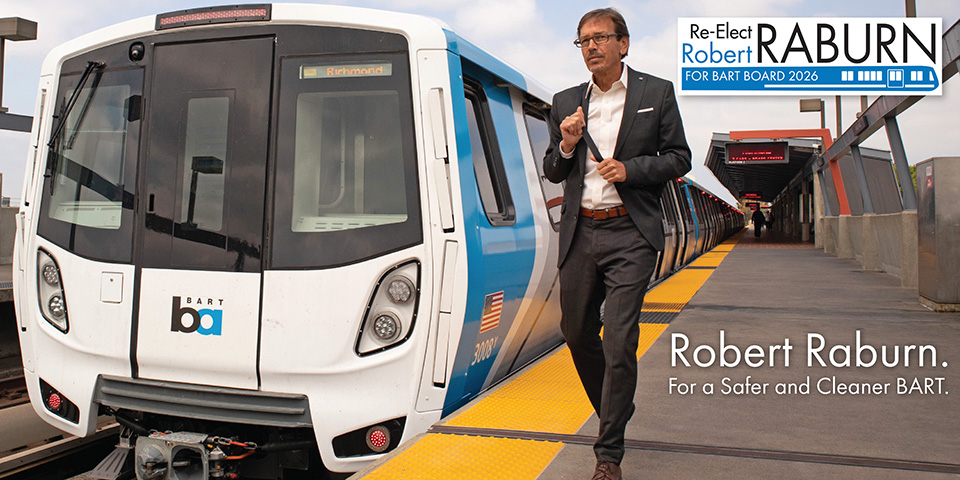
"I Work for You ... Not BART."
Keeping the trains on time is no job for amateurs. With 131 miles of track, 50 stations, 1070 Gen2 BART cars (as of 02/09/26), 184 escalators, 147 elevators, 715 fare gates, and pressure to always do more with less, making BART work for you takes a rare kind of leader.
As a professional transportation planner with 34 years of experience improving transit, Robert Raburn is the expert we need on the BART Board.
A BART Director has to make tough decisions. They have to balance limitless priorities with limited resources. They have to make BART better through innovation, efficiency, and service improvements. They have to lead by example and prove to voters that reinvesting in our core transportation system is worth it. In his 15 years on the BART Board, Director Raburn has shown that he’s up to the task. He was elected to serve as Board President in 2018.
Director Raburn understands how transit works, knows how to make it better, and puts riders first. He often says, “I work for you, not for BART.” He’s the proven leader we need on the BART Board, for the people of District 4 and for everyone who rides BART.
Keeping the lights on at BART requires a financial recovery from the riders lost to remote work trends that clobbered all transit during the pandemic. Director Raburn has been a leader in promoting BART's Safe and Clean Plan as a critical component in winning back transit passengers along with a new business model that is not dependent on passenger payments at the fare box. Like transit systems throughout the nation and the globe, BART, AC Transit, SF Muni and Caltrain will give the voters an opportunity to adopt a regional transit measure at the polls in November 2026 that will support operations costs. Otherwise, the Bay Area risks losing quality transit service and the delivery of transformational transit fare and service integration.
Robert Keeps His Word:

Robert said he would focus
on modernizing BART's Fleet.
He kept his word.
Soon after taking office, Raburn championed modernizing BART’s aging fleet with an order for 775 new BART cars. The last Legacy cars were retired in September 2023 and passengers now only ride in Fleet of the Future trains. Today, BART has received 1070 cars. Of course, Director Raburn insured that there are dedicated spaces for wheelchairs and bicycles in the new trains.
Robert said he would champion
vibrant urban centers at BART stations.
He kept his word.
In 2016, the BART Board adopted a Transit Oriented Development policy that envisions mixed-use development, including 20,000 new housing units on BART property. The bold policy calls for 35% of the units overall, or 7,000, to be affordable. Currently in Oakland, 875 new housing units at MacArthur BART, 110 units were built at Coliseum BART, and Fruitvale BART has added 275 units, including BART’s first supportive services housing for veterans. San Leandro BART features a new Tech Campus and over 250 affordable units. All developments include improvements for walkability and bicycle safety. In anticipation of developments at Bay Fair and Hayward BART, access improvements are either being planned or are underway. Robert’s focus on new housing and jobs near BART addresses our region’s severe housing shortage, meets our climate change goals, and brings residents close to where they work and thrive.

Robert said he would make
BART an environmental leader.
He kept his word.
Robert created BART’s Environmental/Sustainability Committee that led to adoption on December 7, 2017 of monumental wind- and solar-power contracts that commit BART to a renewable energy future. His fight to rebuild BART, Measure RR, met voter approval in November 2016, and BART has issued the first certified Green Bonds to eager investors. The new train cars even regenerate more power when braking. More Bay Area residents walk or bike to ride non-polluting trains than ever before. Robert is doing everything he can to prepare BART for the Bay Area’s green future.
Robert said he would make BART a vital
and equitable workforce development partner.
He kept his word.
At Robert’s urging, BART’s Office of Civil Rights has hosted a number of workshops informing local small businesses about Measure RR’s contracting opportunities with BART. He also spearheaded partnerships with seven regional community colleges and labor apprenticeship programs to create a pipeline to good-paying skilled transit jobs for local students.

Robert said he’d make BART more efficient.
He kept his word.
When voters passed the $3.5B Measure RR, BART promised a bond interest rate no greater than 5%. On account of eager investors, BART's initial $300M Green Bond received a low 3.57% rate—a savings to be passed on to taxpayers. He also successfully advocated for designing new cars that reduce noise levels on BART, saving taxpayers and riders millions of dollars in track maintenance costs.
Robert said he’d make us safer.
He kept his word.
Robert insisted on an earthquake early warning system for BART that will save lives by preventing trains from derailing when “the big one” strikes. He also supported increasing the number of Community Service Officers in BART, leading to more cost-effective patrols throughout the system. Another priority is filling vacancies in the BART Police staffing and ensuring their training includes a focus on harm reduction, diversion, and partnerships with city, county, and state services for at-risk individuals.